reading list
geometry for the future of finance
This is a finance/economics reading list without finance or economics texts. I assume the reader has already scanned the plethora of quantitative finance and economics resources available online and has become disparately bored with them.
If not, start with the normal material: asset pricing, derivatives, econometrics, market microstructure, macroeconomic theory (I recommend Bouchaud’s, Duffie’s, and Mehrling’s texts for starters), and come back when the usual language begins to feel too restrictive.
This list is for the reader who would like to join the lifelong work on the next Renaissance-Technologies-type entity of the 21st century. We imagine running a trading desk on a centrifugal space station, engineering low-Earth-orbit servers, making lunar-mining markets and directing flows of resource claims through an interplanetary economy. This expansive agenda and the future of the human race is part of what excites us.
Finance and economics in modernity has repeatedly absorbed outsiders. During the 20th century, mathematicians, physicists, cryptanalysts, engineers, and computer scientists entered increasingly mechanized markets and helped construct the half-human, half-machine infrastructure of contemporary exchange. The emblematic figure for our purposes is Jim Simons: code breaker, geometer, and collaborator of Shiing-Shen Chern before becoming one of the defining quantitative investors of the modern era and creating the Medallion Fund.
But our concern is not the last financial revolution. It is the next one.
What language is appropriate for an economic order composed of decentralized and traditional institutions, competing collateral systems, automated markets, geopolitical fragmentation, financial warfare, autonomous agents, and eventually off-world production and exchange?
We propose the answer is geometry.
The reading order is chosen to be deliberately strange at first glance.
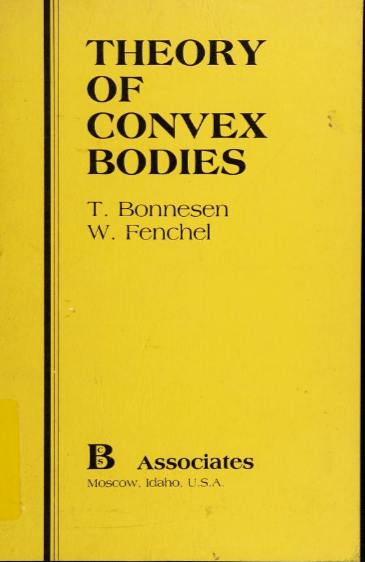
We first stop with inspiration from the economists and portfolio theorists that pervasively reason with classical convex analysis. Hence, we choose the classic text by Bonnesen–Fenchel. It begins with notions in convexity: bodies, support functions, polarity, Minkowski addition, mixed volumes, curvature measures, and geometric inequalities all are introduced in around 150 pages. Before asking how to regress one variable against another, we emphasize that learning to think about feasible sets, boundaries, duality, combinations of objects, and the invariants of their shape is foundational.
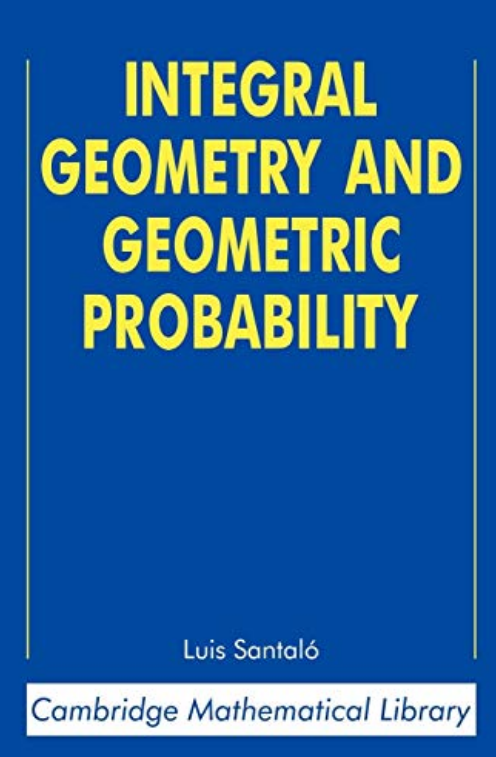
Santaló takes the static convex bodies and introduces probabilistic reasoning with geometric objects such as lines, planes, intersections, projections, and rigid motions; all of which acquire invariant measures that obey group transformation laws. The Crofton and kinematic formulas recover geometric quantities through averaging principles. And the primitive object becomes no longer simply a random variable, but a random geometric configuration acted upon by a symmetry group.
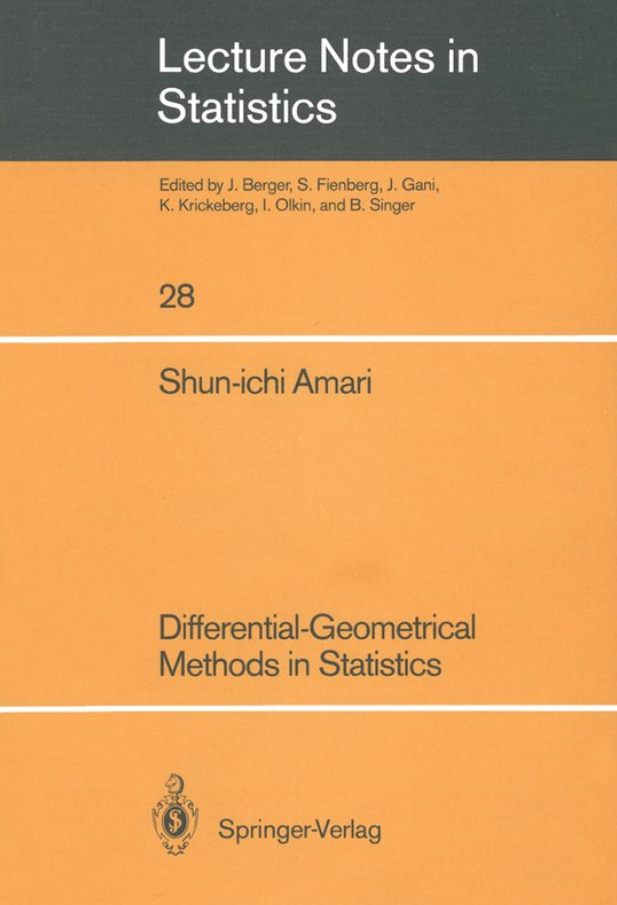
Amari then reverses the previous construction: the probability itself becomes geometrically meaningful. A statistical family is said to be a manifold and the Fisher information is its metric. Exponential and mixture structures generate dual affine connections where divergence, projection, and curvature become the language of inference. Statistics is no longer something performed on a state space. Instead the family of possible laws is itself a geometrical state space. Statistical models embedded as submanifolds become described by higher-order asymptotic theory of curvatures and ancillary statistics.
Ikeda–Watanabe then gives us the modeling tools to describe the kinetic dynamics of static convex constraints and statistical geometries. Martingales lead to methods of stochastic integration, Itô and Stratonovich calculus to stochastic differential equations, SDEs to diffusion generators, and Euclidean diffusion to stochastic flows on manifolds. The text further constructs frame bundles, horizontal lifts, stochastic parallel transport, heat kernels, and Malliavin calculus turn uncertainty into dynamics on curved probability spaces.

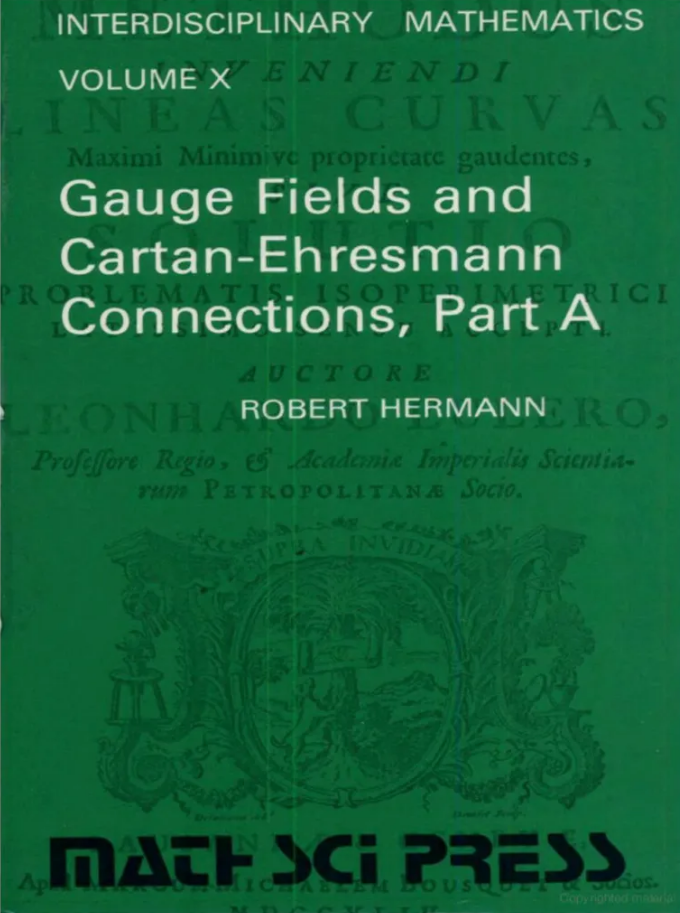
Finally, Hermann supplies the unifying language required for an algebraic theory of connections and parallel transport: bundles, connections, curvature, and gauge fields. Principal bundles and Cartan structures are built to handle nonlinear differential operators and symmetries. Cartan–Ehresmann connections on fiber spaces manifestly contain the horizontal vector field system such that the tangent space splits into a direct sum of the vertical space tangent to the fiber and the horizontal space. This generates the horizontal lift of diffusion processes on manifolds to the geometrical definition of distributions on fiber space. Curvature measures the failure of horizontal transport to integrate globally. Affine, projective, conformal, Poisson, cosymplectic, Yang–Mills, and spinorial constructions become variations on this connection-centered theme.
Thus the reading list follows a rather simple thread from describing the shape of convex sets to their integral and probabilistic geometry. Then stochasticity is introduced and get described by connections, curvature, and ultimately gauge structure.
What does any of this have to do with markets, portfolios, collateral, information, liquidity, economic networks, or interplanetary resource allocation? This is deliberately left as an exercise to the reader.
That exercise is the point.